
A simple solution to the Rubik’s cube:
I believe anyone can solve a Rubik’s cube, it really isn’t as difficult as it seems. It just comes down to a few easy steps to remember. The first important thing to realise is the three types of pieces on the cube. Firstly, the centre pieces, these pieces only have one colour and they don’t move. The centre pieces show which colour should be solved on each side. Next is the edge pieces, these have two colours and should be solved between the two centres they have the colour of. Finally, the corner pieces have three colours and should be solved between the centres of their colours. You should also know that the cube is solved layer by layer rather than side by side.
Notation:
Turns on the Rubik’s cube are represented with notation. R means to turn the right side clockwise, R’ means anticlockwise and R2 means turn it twice. This is the same for L, U, D, F and B, corresponding to the left, top, bottom, front and back respectively. It is worth being somewhat familiar with this before attempting to solve the cube.
The method:
1. The first step is to find the white centre and the goal is to build a cross of the four white edges around it. You also should make sure that the other colour on the edge matches the other centre it connects with. This step is done intuitively so I would recommend playing around with it a bit to see if you can work it out.
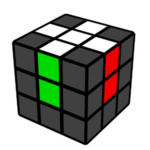
A completed white cross
2. Next, you have to learn a short algorithm. But don’t worry, it is only four moves long. You turn the right layer clockwise (R), the top layer clockwise (U), then the right layer anticlockwise (R’) and the top layer anticlockwise (U’). Practise it a few times so you can do it by memory.
3. Holding your completed white cross on the bottom of the cube, you need to find a white corner piece in the top layer. Now, turn the top layer until the corner is above its slot. For example, for the white-blue-red corner piece you will move it to be between the blue and red centres.
4. Once you have a corner piece above its slot, hold it in the front right with the cross on the bottom and repeat the four move algorithm until it is solved. (It will take between 1 and 5 repetitions). Repeat this for the other three corners. Note: if you can’t find a corner piece in the top layer then it is either in the wrong slot or in its own slot but twisted. If it is in its slot, repeat the four move algorithm until it is solved. If it’s in another slot, do the four move algorithm once which will bring it to the top layer so you can solve it normally.
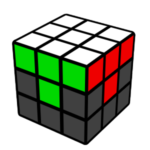
Your cube should look like this
5. Before you begin this step, you have to learn another algorithm. It is just the same as the four move algorithm just on the left side instead (L’ U’ L U). You have solved the first layer and now you are going to solve the second layer. Look at the top layer and find an edge that doesn’t have yellow. Turn the top layer so that the edge matches its centre. Now face the edge and check if the other colour on the edge matches the centre on the left or right.
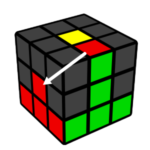
Here is an example of the edge matching the left
6. If it matches the right centre then turn the top layer clockwise and do the four move algorithm with your right hand. Then rotate the cube clockwise and do the four moves with your left hand. If you prefer to use notation then it is U R U R’ U’ rotate L’ U’ L U. If it matches the left centre then turn the top layer anticlockwise and do the left hand four move algorithm. Rotate anticlockwise and do the four moves with your right hand. The notation is U’ L’ U’ L U rotate R U R’ U’. Repeat this for the other three edges. If you can’t find any edges without yellow then it must be in one of the slots. Using one of the above methods, put any edge into the slot, this will move the edge out so you can insert it normally.
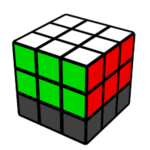
Completed first two layers
7. Now the bottom two layers should be done. When you get to the last layer, look at the yellow edges. There will either be 0, 2 or all 4 facing up. If all 4 are facing up, then you have skipped this step. If there are 2 then it will be a line or a small L. For a line, hold it horizontally, and use the algorithm F R U R’ U’ F’. For a small L, turn the U layer so the L is in the top left. Use the algorithm F R U R’ U’ R U R’ U’ F’ (notice these algorithms are just F then the four move algorithm once or twice then F’). If there are no edges facing up, then do one of the algorithms and it will give you another case. Then do the algorithm for that case. You should now have a yellow cross on top.
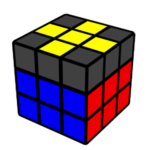
This is a cross on top
8. The next step is to match up the cross edges to the centres. Turn the top layer until 2 edges match. (If they all match, you are done with this step). Hold the 2 matching edges at back and right. (If they are on opposite sides then hold it anywhere). Now use this algorithm: R U R’ U R U2 R’ U. If all edges match up then this step is finished, if not make sure the matching edges are in the back right and do the algorithm again.
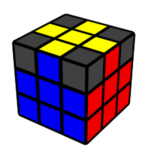
Make sure all edges match at the end of this step.
9. Now all you need to do is solve the corners. First, to solve them into the correct position, find a corner that is in the right place (you can tell if a corner is in the right place if it matches the three other colours around it), then hold it in the front right and use the algorithm U R U’ L’ U R’ U’ L. If there are no corners in the right place, hold any corner in front and do the algorithm. This should solve one corner, so hold it in the front right and do the algorithm.
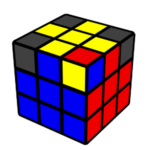
Make sure only one corner is in the right spot when you do the algorithm.
10. At this point everything should be solved except for the yellow corners which should be in the right place just twisted. To solve them, turn the cube upside down so the unsolved corners are on the bottom. Holding an unsolved corner in the front right at the bottom, repeat R U R’ U’ until yellow faces downwards. Then turn the D layer to bring another unsolved corner to the front right and repeat the four moves again until yellow faces down. Keep repeating this for all corners that need solving. Once you have reoriented all the corners, turn the D layer and the cube should be solved.
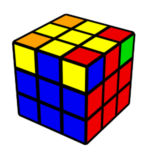
This is the last step but it is easy to mess up so be careful.
Notes/Tips
Getting faster
Once you can solve the cube, you may be wondering how to get faster. While this method (beginner’s method) can get you to solving in around a minute, with a more advanced method you can go far beyond that. One faster method is called CFOP and it is used by the majority of competitive speedcubers. It starts, like the beginner’s method, with a cross (however not always on white). Then you do the first layer corners and second layer edges at the same time in a step called F2L (first two layers). Next, it used and algorithm to orient the last layer, known as OLL, and then another algorithm to solve the last layer, called PLL. This method is considerably more efficient however it is more difficult. You may also want to learn how to solve other puzzles like 2×2, 4×4 or pyraminx, as these can also be learned quite easily. If you are serious about getting faster then I would strongly suggest that you invest in a speedcube. These are Rubik’s cubes that are optimised for performance: they often include magnets and turn much faster and smoother than a Rubik’s brand or other cheap cube. I recommend buying cubes from Kewbzuk (if you are in the UK or Europe).
World records
The world record for the regular 3x3x3 Rubik’s cube is an astonishing 3.13 seconds by Max Park from the USA. China’s Yiheng Wang holds the average world record of 4.48, meaning he solved the cube 5 times with an average time of 4.48s.
Other notable records are Guanbo Wang’s 0.47s 2×2 single, Tommy Cherry’s 12.78s 3×3 blindfolded world record and Graham Siggins’ absolutely unbelievable 62/65 multi-blind attempt.
Other Tutorials
4×4 tutorial – https://jperm.net/4×4
Blindfolded tutorial – https://jperm.net/bld
Important information before viewing your draft website:
Please find your draft website for review. We understand that you may wish to make some changes to your draft site. In order to help you get your new website live as soon as possible, we limit amends to two rounds where possible.
Your account manager will be in touch in the coming days to arrange a suitable time to run through the primary changes with you in detail. Once these are completed, you will have an opportunity to address any final tweaks before we request sign-off.
The go live process
Once we have received sign-off, our go live process involves:
By viewing the website draft you are confirming that you have read and agree to the information above.
Please note the design can vary across desktop and mobile devices. To view all of your pages, please use the navigation menu in the website footer.
If you have any questions, please contact your Project Manager or Business Development Manager.